
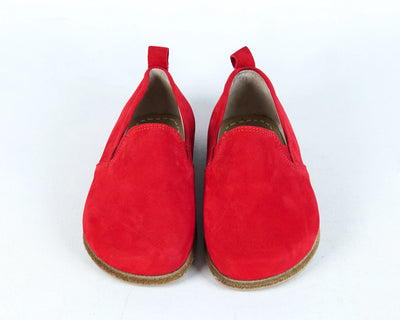
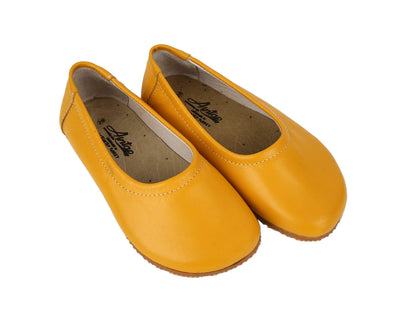
Home / Why barefoot

Why barefoot

Ordinary shoes vs Aintap

Ordinary shoeaintapbarefoot
Toe boxTapered, toes pressed togetherFoot-shaped, toes spread
Heel heightRaised heel (2–4 cm)Zero drop
SoleThick, stiff, cushionedThin and flexible (leather or 6 mm rubber)
LeatherOften chrome-tanned or syntheticVegetable-tanned, top grain
GroundingRubber blocks contactCopper-rivet option
MadeMass-producedBy hand, to order, in Gaziantep

What changes when your shoe follows your foot

Barefoot footwear is a simple idea: make the shoe the shape of a foot, then get out of the way.

Room for your toes

The toe box is as wide as your forefoot, so toes rest flat and spread naturally instead of being pushed inward. Many people with bunions or wide feet find this the biggest relief.

Zero drop

Heel and toes sit at the same height. Without a raised heel, your ankles, knees and back settle into a natural, upright posture.

Thin, flexible sole

A 6 mm rubber or natural leather sole bends with your foot and lets you feel the ground, so the small muscles of your foot do their job.

Vegetable-tanned leather

Tanned with plant tannins instead of chrome. It breathes, moulds to your foot over time and has almost no chemical residue against your skin.

Copper rivet for grounding

Models marked with the copper rivet carry a pure copper rivet that connects your skin with the ground beneath you, the way walking barefoot does.

New to barefoot shoes? Start with a few hours a day and build up over two to three weeks while your feet adapt.

What the research says

Independent, peer-reviewed studies on barefoot footwear and grounding. We list who did the study, how big it was and what they found.

See all research
Barefoot footwearRandomised controlled trial · 57 runners · 8 weeks

After 8 weeks, the minimalist-shoe group had bigger and stronger foot muscles, about as much as the exercise group. The group that changed nothing did not improve.

What it means for you: Simply walking in shoes that let your foot move trains the small muscles that support your arch.

Ridge ST, Olsen MT, Bruening DA, et al. Walking in Minimalist Shoes Is Effective for Strengthening Foot Muscles. Medicine & Science in Sports & Exercise. 2019;51(1):104–113. Read the study

Barefoot footwearNature · field and lab study in Kenya and the USA

Barefoot walkers' feet stayed just as sensitive to the ground. Cushioned shoes, in contrast, reduced how much the foot can feel.

What it means for you: A thin, flexible sole keeps the feedback your feet use for balance.

Holowka NB, Wynands B, Drechsel TJ, et al. Foot callus thickness does not trade off protection for tactile sensitivity during walking. Nature. 2019;571:261–264. Read the study

Barefoot footwearLab study · 22 middle-aged and older adults

Participants were more stable standing and walking in most minimal shoes than in conventional shoes, and moved faster in a functional test with a wider minimal sole.

What it means for you: A wide, flexible, flat shoe can help you feel steadier on your feet as you get older.

Cudejko T, Gardiner J, Akpan A, D'Août K. Minimal footwear improves stability and physical function in middle-aged and older people compared to conventional shoes. Clinical Biomechanics. 2020;71. Read the study

How grounding works in an Aintap shoe

  1. ContactA pure copper rivet passes through the sole. Inside it touches your skin, outside it touches the ground.
  2. ConnectionOn soil, grass, sand, stone or unsealed concrete the rivet creates a conductive path between you and the earth. Rubber, asphalt and wooden floors block it.
  3. BalanceYour body takes on the electrical potential of the ground, the same effect researchers create with conductive mats and sheets in grounding studies.

Questions before your first pair

How should I choose my size?
Order your usual size. Measure your foot from heel to longest toe and compare it with the insole length in our size chart. If you are between sizes, take the larger one.
Which models support grounding?
Grounding needs a conductive path between your skin and the earth. Models marked “copper rivet” on their product page have one. Ask us if you are unsure about a specific pair.
How long does delivery take?
Each pair is made to order in 3–5 working days, then shipped with UPS. Most orders arrive within 7–12 days.
Can I return or exchange?
Yes, within 14 days of delivery. US returns go to our US warehouse; other countries ship back to our workshop in Türkiye.
Will I feel the ground too much?
You will feel more than in a cushioned shoe, which is the point. Most people adapt within a couple of weeks. Start on even surfaces.